



Free 100 Number Chart Printable for Kids
Help your child master counting, skip counting, and number patterns with this free 100 number chart printable.
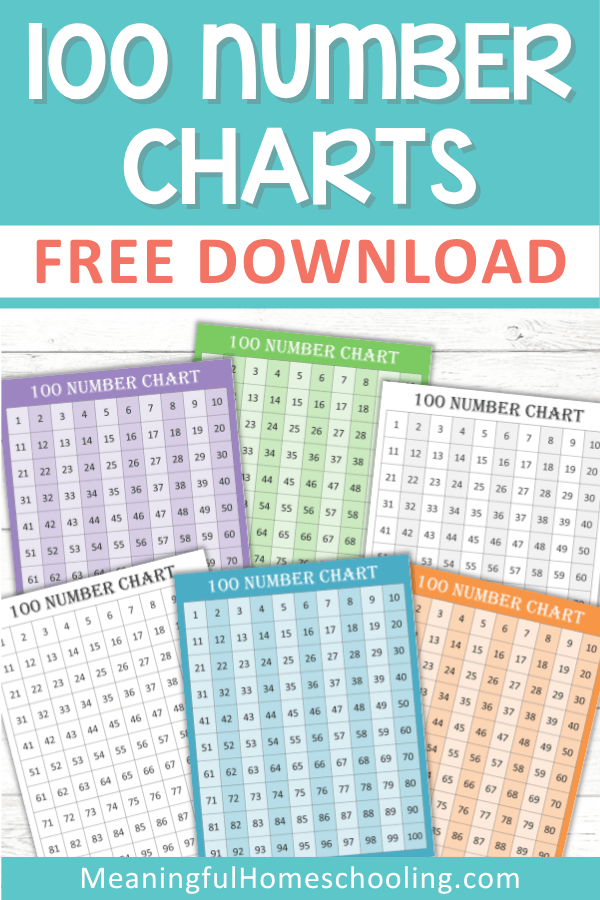
Whether your child is just learning numbers, practicing skip counting, or working on basic addition and subtraction, a 100s number chart will make math more visual and easier to understand. A printable hundreds chart is a simple and effective tool for building number sense.
In this guide, you’ll find free printable 100 number charts, fun learning activities, and simple ways to use number charts with kids in pre-K through second grade.
Scroll down to get your free 100 number charts!
What Is a 100s Number Chart?
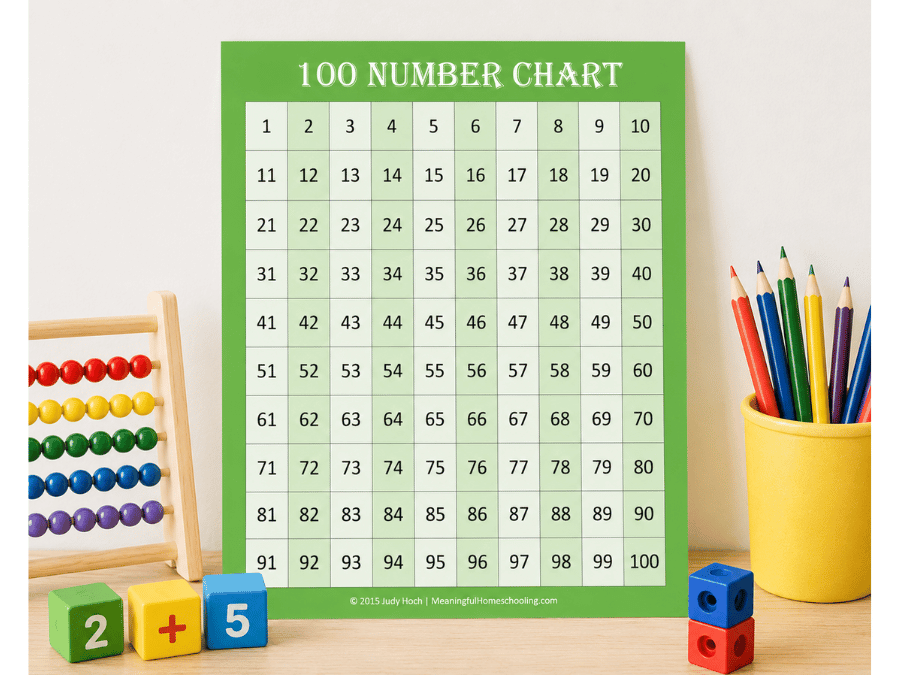
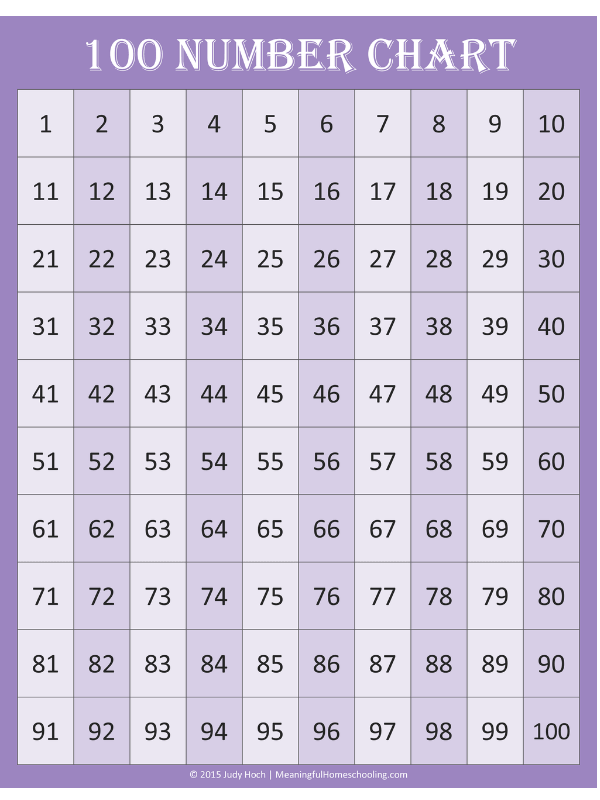
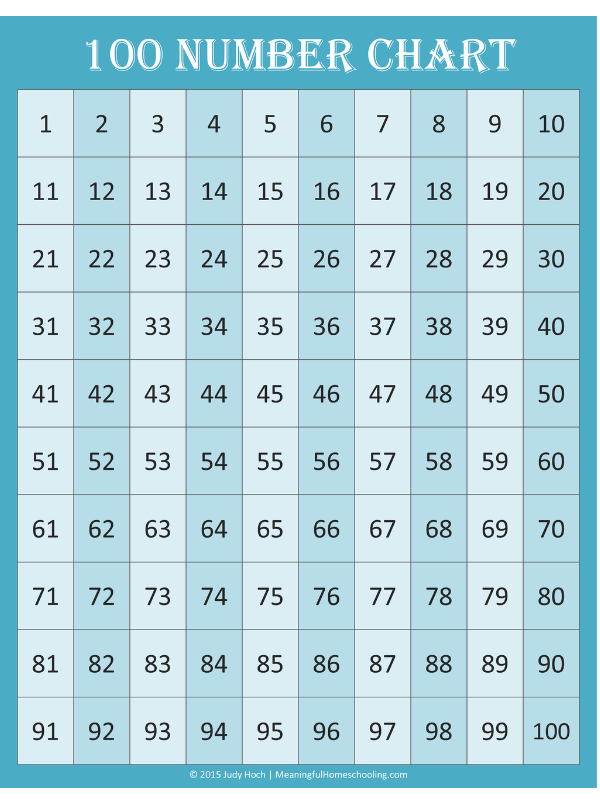
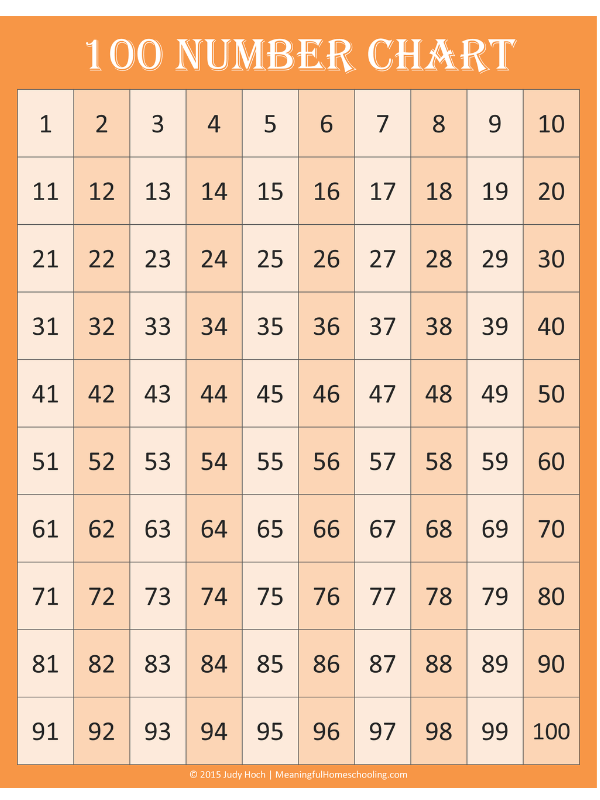
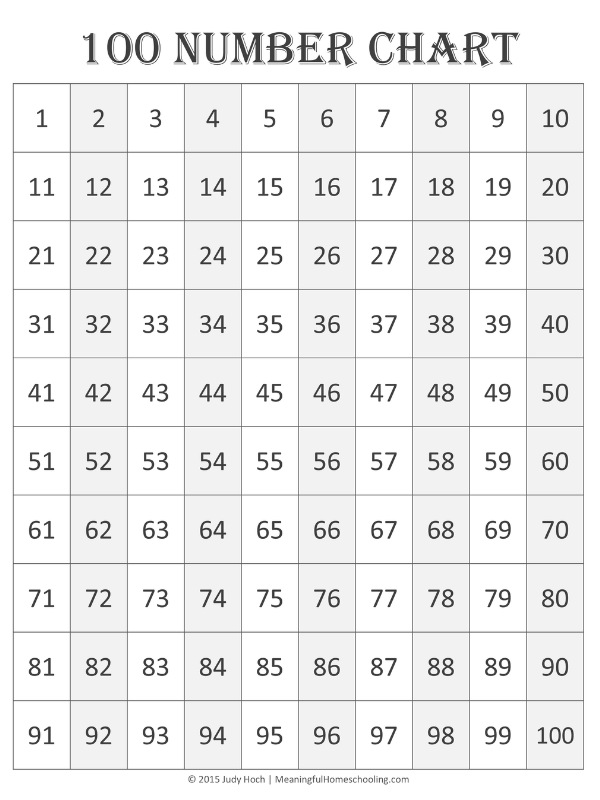
A 100s number chart (also called a hundreds chart) is a grid that displays the numbers 1 through 100 in order. Each row contains ten numbers, helping children recognize patterns and understand how numbers relate to one another.
Parents and teachers use hundreds charts to teach:
- Counting to 100
- Number recognition
- Even and odd numbers
- Skip counting
- Place value
- Early addition and subtraction
Math Skills Kids Can Practice with a 100 Numbers Chart
A 100 numbers chart is much more than a counting tool. It’s a versatile visual aid that helps children in preschool through second grade develop essential math skills they’ll use throughout elementary school.
By exploring patterns, solving simple problems, and talking about numbers together, kids build confidence while strengthening their overall number sense.
Here are some of the most important skills children can practice with a 100 number chart:
1. Number Recognition
Young learners can identify and name numbers from 1 to 100, helping them become more familiar with number symbols and their order. Point to a number and ask your child to read it aloud, or call out a number and have them find it on the chart.
2. Counting Forward and Backward
Practice counting from any starting number instead of always beginning at 1. Children can also count backward to build flexibility with numbers and prepare for subtraction.
3. Even and Odd Numbers
Color all of the even numbers one color and the odd numbers another. Children will quickly notice that even numbers end in 0, 2, 4, 6, or 8, while odd numbers end in 1, 3, 5, 7, or 9.
4. One More and One Less
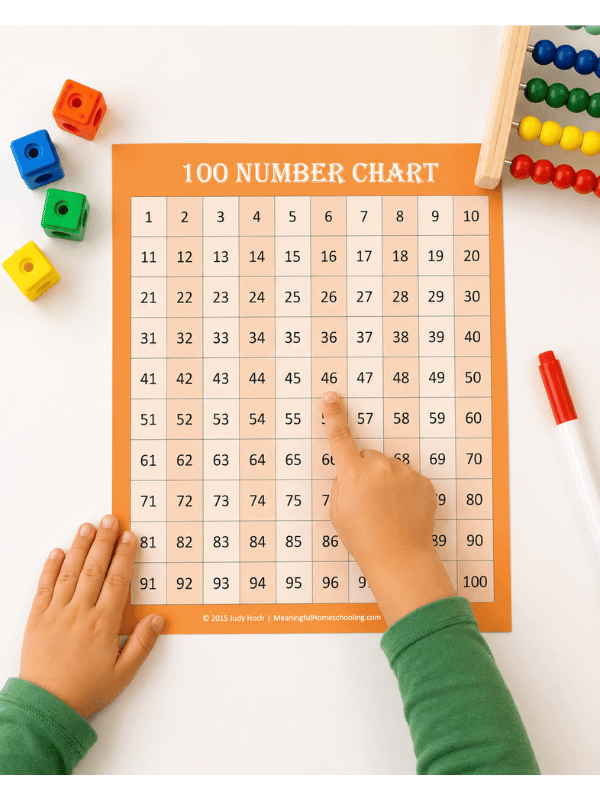
Ask questions like, “What number is one more than 46?” or “What number is one less than 72?” Since numbers increase by one as you move across the chart, children quickly begin to recognize these relationships.
5. Ten More and Ten Less
One of the biggest benefits of a hundreds chart is helping children understand place value. Moving down one row adds 10, while moving up one row subtracts 10. This visual pattern makes it easier for children to grasp how tens and ones work together.
6. Skip Counting
Use the chart to practice counting by 2s, 5s, and 10s. Highlighting these number patterns helps children prepare for multiplication while strengthening their understanding of repeated addition.
7. Place Value
As children explore the chart, they begin noticing that numbers in the same column share the same ones digit. For example, 14, 24, 34, and 44 all end in 4. These patterns reinforce the concept of tens and ones, an important kindergarten through second-grade math skill.
8. Comparing Numbers
Ask questions like, “Which number is greater?” or “Which number comes before 58?” These activities strengthen children’s understanding of number order and comparison.
9. Finding Number Patterns
Encourage your child to look for repeating patterns across rows and columns. They might notice that each row contains ten numbers, every column shares the same ones digit, or that multiples of 5 create a recognizable pattern. Discovering these relationships helps children develop strong mathematical reasoning skills.
10. Building Problem-Solving Skills
Turn the chart into a game by giving your child clues to solve. For example:
- “I’m thinking of a number that’s greater than 50 but less than 60.”
- “It’s an even number.”
- “It ends with a 6.”
These simple number riddles encourage logical thinking while reinforcing multiple math concepts at the same time.
Get Your Free 100 Number Chart Printables
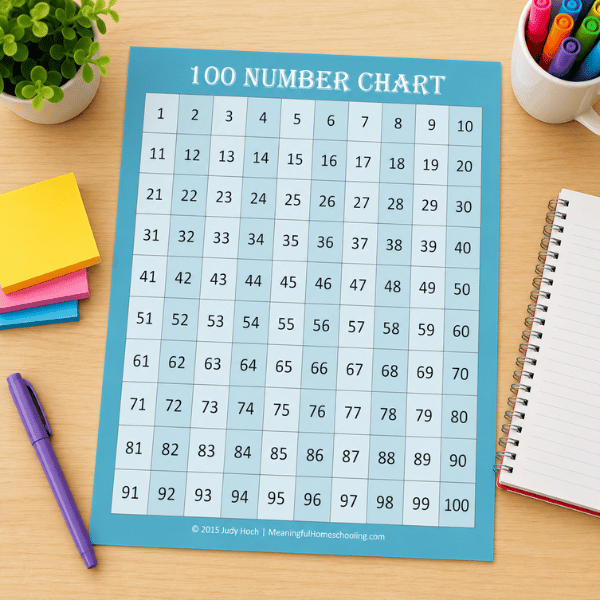
Ready to start learning? Enter your email below to download our free printable 100 number charts. You’ll also receive more fun educational printables, learning activities, and teaching tips delivered right to your inbox!
10 Fun Ways to Use a 100 Number Chart
A 100 number chart is much more than a counting tool. It’s the starting point for countless hands-on math games. Whether you’re homeschooling, helping with homework, or looking for screen-free activities, these simple games make learning numbers exciting while building important math skills.
1. Number Detective
Call out a number and ask your child to find it on the chart as quickly as possible. As they improve, make the clues more challenging:
- “Find a number between 40 and 50.”
- “Find an odd number that ends in 7.”
- “Find a number that’s ten more than 24.”
This game strengthens number recognition and critical thinking.
2. Roll and Cover
Grab a pair of dice and a handful of counters or coins. Roll the dice, add the numbers together, and cover that sum on the 100 chart. Keep rolling until someone covers an entire row, column, or diagonal.
For older children, use two 10-sided dice to generate larger numbers.
3. Skip Counting Treasure Hunt
Choose a number pattern like counting by 2s, 5s, or 10s. Have your child color or place a marker on every matching number until they discover the hidden pattern. Then ask questions like:
- What do you notice?
- Which numbers repeat?
- Where do the patterns appear on the chart?
4. Mystery Number
Think of a number on the chart and give clues one at a time.
For example:
- “My number is greater than 50.”
- “It’s an even number.”
- “It ends in 8.”
Can your child guess the mystery number before you run out of clues?
5. Race to 100
Players start at 1. Roll a die and move that many spaces on the chart. The first player to reach exactly 100 wins.
To make the game more challenging, use two dice or include special rules like:
- Roll a 6 and move ahead 10 spaces.
- Land on a multiple of 5 and take another turn.
6. Color the Patterns
Give your child crayons or markers and challenge them to color:
- Even numbers blue
- Odd numbers red
- Multiples of 5 green
- Multiples of 10 yellow
Afterward, talk about the patterns they notice. This activity helps children visualize number relationships while reinforcing skip counting and place value.
7. One More, One Less Challenge
Point to any number and ask:
- What is one more?
- What is one less?
- What is ten more?
- What is ten less?
Have your child move their finger around the chart to find each answer. Over time, they’ll begin solving these mentally without relying on the chart.
8. Fill in the Missing Numbers
Cover several numbers with sticky notes or small pieces of paper. Challenge your child to figure out the hidden numbers using the surrounding numbers as clues.
This activity encourages children to think about number order instead of simply counting from the beginning.
9. Hundreds Chart Bingo
Instead of traditional bingo cards, use a blank 100 chart. Call out numbers, number clues, or simple math problems, and have players cover the correct squares. The first person to complete a row, column, or four corners wins.
10. Find the Hidden Path
Create a secret path by writing down a sequence of numbers, such as:
3 → 13 → 23 → 33 → 43 → 53
Have your child connect the numbers with a marker and guess the rule. Then let them create their own hidden paths for you to solve using patterns like:
- Count by 2s
- Count by 5s
- Count by 10s
- Add 11 each time
- Diagonal patterns
Frequently Asked Questions
1. What age is a 100 number chart for?
Most children begin using one between ages 4 and 7, including preschool through grade 2.
2. Is a hundreds chart the same as a 100 number chart?
Yes. Both names describe a chart displaying the numbers 1 through 100.
3. How do teachers use a hundreds chart?
Teachers use them for counting practice, skip counting, place value, number patterns, addition, subtraction, and interactive math games.


I just saw your Hymn studies posted on facebook and hopped on over and fell in love with your blog. So, now, I’m your newest follower. I love the list of free kindle books, too. Thank you so much for sharing.
Thanks so much for following, Patty! Your comment made my day. 🙂
This is such a handy printable! Thanks for sharing! It’s definitely something every K-2 math class needs!! 🙂
I’m glad it’s helpful, Bethany! I agree that it’s and excellent learning tool for K-2 (and hey, I kinda like them myself!) 🙂
This is awesome, but one of my first graders found an error … you have a 59 where the 69 should be! If you are able to correct I will re-download! I really appreciate your making and sharing such an awesome resource! We will use this almost every day!!! THANKS!
Ahhh! You are right. I definitely will correct these, BUT I’m in the middle of a project – so it may be a few days or even a week. Thank you so much for letting me know!!
How to get this 100 charts for use in the classroom
I found a purple version of these on pinterest but not on your site. I was so excited as that’s my youngests favorite color. Is a purple one still available? Thank you.
Hi Heather, I don’t have the purple one anymore. I’m sorry. 🙁
You could print the white version out on purple paper. I printed it out on 6 different colors of cardstock and then cut them into 6-8 pieces along the lines to make “puzzles”. There are so many things you can do with this chart. 🙂
Hi, thanks for sharing but can you help me by saying how to use the chart in my classes.
I really appreciate if You help me.
Hi Elsa! You can use the chart to help with counting, skip counting, number correspondence, and much more! You can use the blank chart for kids to fill in the numbers themselves. I hope this helps!
Very helpful